
Helpful Tools & Resources
INCOTERMS
The Incoterms or International Commercial Terms are a series of pre-defined commercial terms published by the International Chamber of Commerce (ICC) relating to international commercial law.
Read more
INCOTERMS
The incoterms define the role between seller and buyer at an international transaction. The Incoterms 2010 rules are standard sets of trading terms and conditions designed to assist traders when goods are sold and transported.
Each Incoterms rule specifies:
- the obligations of each party (e.g. who is responsible for services such as transport; import and export clearance etc)
- the point in the journey where risk transfers from the seller to the buyer
So by agreeing on an Incoterms rule and incorporating it into the sales contract, the buyer and seller can achieve a precise understanding of what each party is obliged to do, and where responsibility lies in event of loss, damage or other mishap.
The eleven rules are divided into two main groups
The incoterms define the role between seller and buyer at an international transaction. The Incoterms 2010 rules are standard sets of trading terms and conditions designed to assist traders when goods are sold and transported.
Each Incoterms rule specifies:
So by agreeing on an Incoterms rule and incorporating it into the sales contract, the buyer and seller can achieve a precise understanding of what each party is obliged to do, and where responsibility lies in event of loss, damage or other mishap.
The eleven rules are divided into two main groups
Each Incoterms rule specifies:
- the obligations of each party (e.g. who is responsible for services such as transport; import and export clearance etc)
- the point in the journey where risk transfers from the seller to the buyer
So by agreeing on an Incoterms rule and incorporating it into the sales contract, the buyer and seller can achieve a precise understanding of what each party is obliged to do, and where responsibility lies in event of loss, damage or other mishap.
The eleven rules are divided into two main groups
Rules for any transport mode
- Ex Works EXW
- Free Carrier FCA
- Carriage Paid To CPT
- Carriage & Insurance Paid to CIP
- Delivered At Terminal DAT
- Delivered At Place DAP
- Delivered Duty Paid DDP
Rules for sea & inland waterway only
- Free Alongside Ship FAS
- Free On Board FOB
- Cost and Freight CFR
- Cost Insurance and Freight CIF
In general the “transport by sea or inland waterway only” rules should only be used for bulk cargos (e.g. oil, coal etc) and non-containerised goods, where the exporter can load the goods directly onto the vessel. Where the goods are containerised, the “any transport mode” rules are more appropriate.

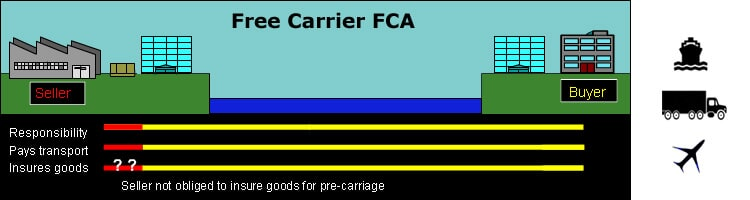
Free Carrier (FCA)
Can be used for any transport mode, or where there is more than one transport mode.
A very flexible rule that is suitable for all situations where the buyer arranges the main carriage.
In all cases, the seller is responsible for export clearance; the buyer assumes all risks and costs after the goods have been delivered at the named place.
Free Carrier (FCA)
Can be used for any transport mode, or where there is more than one transport mode.
A very flexible rule that is suitable for all situations where the buyer arranges the main carriage.
In all cases, the seller is responsible for export clearance; the buyer assumes all risks and costs after the goods have been delivered at the named place.
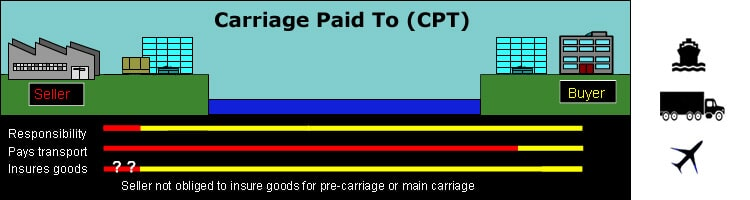
Carriage Paid To (CPT)
Can be used for any transport mode, or where there is more than one transport mode.
The seller is responsible for arranging carriage to the named place, but not for insuring the goods to the named place. However delivery of the goods takes place, and risk transfers from seller to buyer, at the point where the goods are taken in charge by a carrier.
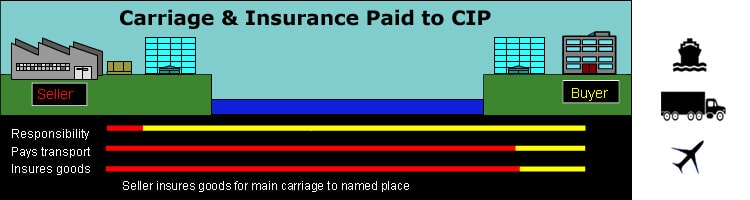
Carriage and Insurance Paid To (CIP)
Can be used for any transport mode, or where there is more than one transport mode.
The seller is responsible for arranging carriage to the named place, and also for insuring the goods. As with CPT, delivery of the goods takes place, and risk transfers from seller to buyer, at the point where the goods are taken in charge by a carrier
Delivered at Terminal (DAT)
Can be used for any transport mode, or where there is more than one transport mode.
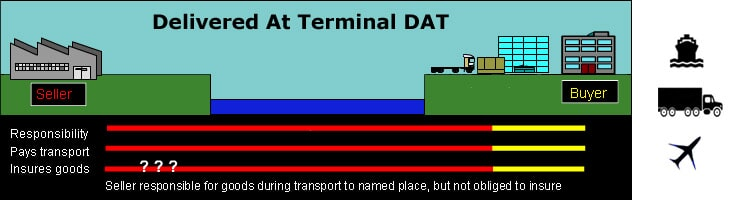
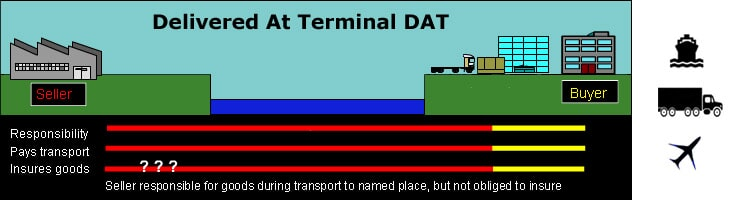
The seller is responsible for arranging carriage and for delivering the goods, unloaded from the arriving conveyance, at the named place.
Risk transfers from seller to buyer when the goods have been unloaded.
‘Terminal’ can be any place – a quay, container yard, warehouse or transport hub.
The buyer is responsible for import clearance and any applicable local taxes or import duties.
Delivered at Place (DAP)
Can be used for any transport mode, or where there is more than one transport mode. The seller is responsible for arranging carriage and for delivering the goods, ready for unloading from the arriving conveyance, at the named place. (An important difference from Delivered At Terminal DAT, where the seller is responsible for unloading.)
Risk transfers from seller to buyer when the goods are available for unloading; so unloading is at the buyer’s risk.
The buyer is responsible for import clearance and any applicable local taxes or import duties.
This rule can often be used to replace the Incoterms 2000 rules Delivered At Frontier (DAF), Delivered Ex Ship (DES) and Delivered Duty Unpaid (DDU)
Delivered Duty Paid (DDP)
Can be used for any transport mode, or where there is more than one transport mode.
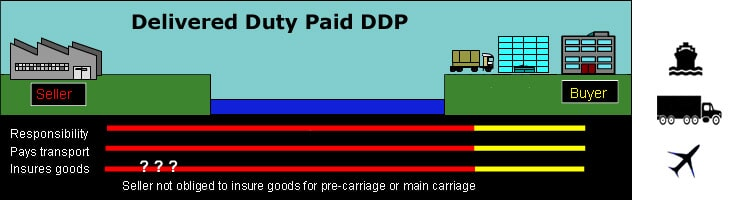
The seller is responsible for arranging carriage and delivering the goods at the named place, cleared for import and all applicable taxes and duties paid (e.g. VAT, GST).
Risk transfers from seller to buyer when the goods are made available to the buyer, ready for unloading from the arriving conveyance.
This rule places the maximum obligation on the seller, and is the only rule that requires the seller to take responsibility for import clearance and payment of taxes and/or import duty.
Free Alongside Ship (FAS)
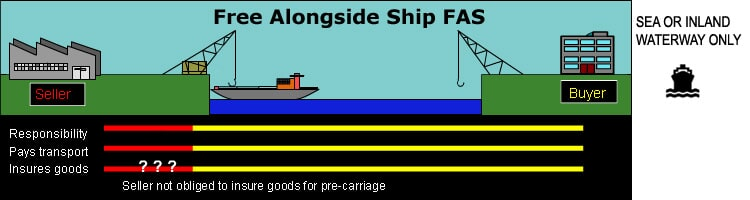
Use of this rule is restricted to goods transported by sea or inland waterway.
In practice it should be used for situations where the seller has direct access to the vessel for loading, e.g. bulk cargos or non-containerised goods.
For containerised goods, consider “Free Carrier FCA” instead.
Seller delivers goods, cleared for export, alongside the vessel at a named port, at which point risk transfers to the buyer.
The buyer is responsible for loading the goods and all costs thereafter.
Free On Board (FOB)
Use of this rule is restricted to goods transported by sea or inland waterway.
In practice it should be used for situations where the seller has direct access to the vessel for loading, e.g. bulk cargos or non-containerised goods.
For containerised goods, consider “Free Carrier FCA” instead.
Seller delivers goods, cleared for export, loaded on board the vessel at the named port.
Once the goods have been loaded on board, risk transfers to the buyer, who bears all costs thereafter. Cost and Freight (CFR)
Use of this rule is restricted to goods transported by sea or inland waterway.
In practice it should be used for situations where the seller has direct access to the vessel for loading, e.g. bulk cargos or non-containerised goods.
For containerised goods, consider ‘Carriage Paid To CPT’ instead.
Seller arranges and pays for transport to named port. Seller delivers goods, cleared for export, loaded on board the vessel.
Cost Insurance and Freight (CIF)
Use of this rule is restricted to goods transported by sea or inland waterway.
In practice it should be used for situations where the seller has direct access to the vessel for loading, e.g. bulk cargos or non-containerised goods.
For containerised goods, consider ‘Carriage and Insurance Paid CIP’ instead.
Seller arranges and pays for transport to named port. Seller delivers goods, cleared for export, loaded on board the vessel.
Seller also arranges and pays for insurance for the goods for carriage to the named port.
Use of this rule is restricted to goods transported by sea or inland waterway.
In practice it should be used for situations where the seller has direct access to the vessel for loading, e.g. bulk cargos or non-containerised goods.
For containerised goods, consider “Free Carrier FCA” instead.
Seller delivers goods, cleared for export, loaded on board the vessel at the named port.
Once the goods have been loaded on board, risk transfers to the buyer, who bears all costs thereafter.

Use of this rule is restricted to goods transported by sea or inland waterway.
In practice it should be used for situations where the seller has direct access to the vessel for loading, e.g. bulk cargos or non-containerised goods.
For containerised goods, consider ‘Carriage Paid To CPT’ instead.
Seller arranges and pays for transport to named port. Seller delivers goods, cleared for export, loaded on board the vessel.

Use of this rule is restricted to goods transported by sea or inland waterway.
In practice it should be used for situations where the seller has direct access to the vessel for loading, e.g. bulk cargos or non-containerised goods.
For containerised goods, consider ‘Carriage and Insurance Paid CIP’ instead.
Seller arranges and pays for transport to named port. Seller delivers goods, cleared for export, loaded on board the vessel.
Seller also arranges and pays for insurance for the goods for carriage to the named port.
GLOSSARY OF LOGISTICS, PORT & SHIPPING TERMS
Air Cargo: Freight that is moved by air transportation.
Air Carrier: An enterprise that offers transportation service via air.
Air Waybill (AWB): A bill of lading for air transport that serves as a receipt for the shipper, indicates that the carrier has accepted the goods listed, obligates the carrier to carry the consignment to the airport of destination according to specified conditions.
Bill of Lading (BOL): A transportation document that is the contract of carriage containing the terms and conditions between the shipper and carrier.
Read more
Air Carrier: An enterprise that offers transportation service via air.
Air Waybill (AWB): A bill of lading for air transport that serves as a receipt for the shipper, indicates that the carrier has accepted the goods listed, obligates the carrier to carry the consignment to the airport of destination according to specified conditions.
Bill of Lading (BOL): A transportation document that is the contract of carriage containing the terms and conditions between the shipper and carrier.
Read more